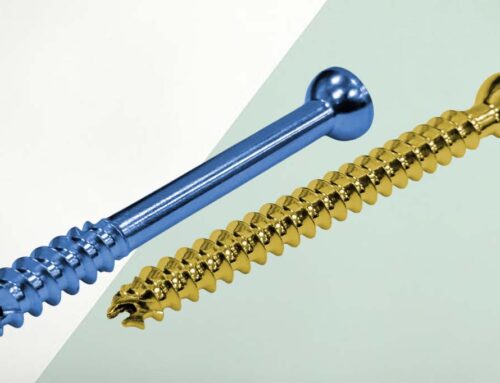
Cancellous screws are specialized orthopedic screws designed specifically for fixation in spongy (cancellous) bone, which is less dense and more porous than cortical bone. These screws are commonly used in orthopedic surgeries involving metaphyseal regions (ends of long bones) like the proximal femur, distal femur, proximal humerus, and pelvis.
Design Characteristics:
- Threaded portion: Large, coarse threads designed to grip the soft cancellous bone securely.
- Core diameter: Thinner than cortical screws, allowing easier insertion into softer bone.
- Tip: Often has a self-tapping or self-drilling design to reduce the need for pre-drilling.
- Length: Available in both fully threaded and partially threaded versions:
- Partially threaded screws allow for interfragmentary compression.
- Fully threaded screws are used when full-length purchase is needed.
Materials:
- Usually made of stainless steel or titanium, offering strength and biocompatibility.
Thread Pitch:
- Has a larger pitch (distance between threads) than cortical screws, allowing better hold in cancellous bone by increasing thread engagement.
Types of Cancellous Screws
Here are the detailed types of cancellous screws, categorized by their structure, function, and surgical use:
Partially Threaded Cancellous Screws
Description:
- Threaded only on the distal (far) portion.
- The proximal portion (shaft) is smooth, allowing for interfragmentary compression.
- Commonly used as lag screws.
Uses:
- To compress two bone fragments across a fracture line.
- Frequently used in fractures of the femoral neck, ankle, or olecranon.
Advantages:
- Strong axial compression.
- Promotes fast healing by stabilizing bone fragments.
Fully Threaded Cancellous Screws
Description:
- Threads run along the entire length of the screw.
- Provide uniform fixation throughout the cancellous bone.
Uses:
- Used when compression is not required, such as in non-compressive fixation or support.
- Common in arthrodesis (joint fusion) or osteotomy fixation.
Advantages:
- Secure anchorage in soft bone.
- Ideal for osteoporotic bone where full-length grip is needed.
Cannulated Cancellous Screws
Description:
- Have a central hollow core, allowing them to be inserted over a guide wire (K-wire).
- Available in both partially and fully threaded forms.
Uses:
- Used in minimally invasive surgeries, where accurate screw placement is essential.
- Commonly used in femoral neck fractures, scaphoid fractures, and slipped capital femoral epiphysis (SCFE).
Advantages:
- Precise alignment with minimal soft tissue trauma.
- Faster and safer screw placement.
Headless Cancellous Screws
Description:
- Do not have a screw head; they sit flush or below the bone surface.
- Often self-compressing with variable pitch threads at both ends.
Uses:
- Ideal for small bone fractures, especially in the hand, foot, or wrist.
- Used in areas where hardware prominence can cause irritation.
Advantages:
- Eliminates need for hardware removal.
- Reduces soft tissue irritation.
- Aesthetically beneficial in cosmetic-sensitive regions.
Bioabsorbable Cancellous Screws
Description:
- Made from biodegradable polymers like polylactic acid (PLA).
- Absorbed by the body over time.
Uses:
- Used in pediatric orthopedics or cases where long-term hardware is not desired.
- Common in sports injuries, especially in ligament and meniscal repairs.
Advantages:
- No need for implant removal.
- Reduces risk of implant-related complications.
Summary Table:
| Type | Key Feature | Common Use |
| Partially Threaded | Smooth shaft, distal thread | Lag screw for fracture compression |
| Fully Threaded | Threaded along entire length | Non-compressive fixation in cancellous bone |
| Cannulated | Hollow core, fits over guide wire | Minimally invasive and precise fixation |
| Headless | No head, sits flush in bone | Small bone fixation (hand/foot) |
| Bioabsorbable | Made of resorbable material | Pediatric & temporary fixation applications |
Advantages of Cancellous Screws
Here is a detailed explanation of the advantages of cancellous screws in orthopedic surgery, especially when used in spongy or trabecular bone areas like the metaphysis of long bones:
Excellent Purchase in Spongy Bone
- Cancellous screws have a wider thread pitch and deeper threads, allowing for better grip in the porous, less dense structure of cancellous bone.
- They provide strong mechanical fixation even in osteoporotic or soft bone, where cortical screws may fail.
Effective Compression Across Fracture Lines
- Partially threaded cancellous screws are ideal for lag screw techniques, where they compress two bone fragments together.
- This compression:
- Enhances bone healing and stability
- Promotes primary bone union
- Minimizes micro-motion at the fracture site
Versatility in Design and Application
- Available in fully threaded, partially threaded, cannulated, headless, and bioabsorbable versions.
- Can be used for a wide range of conditions:
- Fracture fixation
- Arthrodesis (joint fusion)
- Bone graft stabilization
- Osteotomy fixation
Cannulated Design Enables Precision
- Cannulated cancellous screws are inserted over a guide wire, allowing:
- High accuracy
- Less soft tissue dissection
- Quicker surgical procedures
- Particularly useful in minimally invasive surgery and in anatomically challenging areas (e.g., femoral neck, scaphoid).
Headless Screws Reduce Soft Tissue Irritation
- Headless cancellous screws can be buried below the bone surface, reducing the risk of:
- Soft tissue irritation
- Pain
- Need for future hardware removal
- Particularly beneficial in hand, foot, and cosmetic-sensitive areas.
Bioabsorbable Options Eliminate Removal Surgery
- Bioabsorbable cancellous screws are gradually broken down by the body.
- They reduce the need for a second surgery to remove the implant, especially in:
- Pediatric patients
- Sports injuries
- Temporary fixation scenarios
Promotes Early Mobilization
- Stable fixation provided by cancellous screws allows for early joint mobilization and rehabilitation.
- This minimizes risks of complications like joint stiffness, muscle atrophy, or deep vein thrombosis (DVT).
Summary of Advantages
| Advantage | Benefit |
| Strong grip in cancellous bone | Secure fixation in soft or osteoporotic bone |
| Compression capability | Promotes bone healing and stability |
| Versatile configurations | Wide applicability in fractures, fusions, and grafts |
| Precision with cannulated design | Minimally invasive, reduced surgical trauma |
| Headless design minimizes irritation | No hardware prominence; no need for removal |
| Bioabsorbable materials | Avoid second surgery; ideal for growing bone in pediatrics |
| Enables early mobilization | Quicker recovery and improved functional outcome |
Cancellous Screws Providing company in India
HEMC Ortho (Hospital Equipment Manufacturing Company), a leading orthopedic‑implants and instruments manufacturer based in Noida, India:
Company Profile & Overview
Founded: 1981 in Noida, Uttar Pradesh
Team: Over 100 skilled employees across production, inspection, dispatch, R&D, and customer support
Export House: Recognized by the Government of India; HEMC exports globally under OEM arrangements, serving markets in the Americas, Europe, Africa, Latin America, and more.
Certifications & Quality Assurance
- Holds CE, FDA, GMP, and ISO certifications—mandatory for exports to developed regions
- Implements strict in‑house Quality Control; products feature a secure HEMC hologram guaranteeing authenticity
Products & Capabilities
Orthopaedic Implants & Instrument Sets
- Materials: High-grade stainless steel & titanium
- Key Product Lines
- Locking Plates & Screws
- Interlocking Nails & Screws, Cannulated Screws
- External Fixators
- Pelvic Trauma & PFNA Nailing System
- Hip Prostheses, Spine & Craniomaxillofacial Implants
- Mini/Large fragment instrument sets
- General surgical instruments (e.g., bone clamps, curettes, mallets, etc.)
Global Reach & Services
- Logistics: Full support from order placement to installation; 24/7 post‑sales customer service.
- Marketing & Support: Distributor network across 60+ countries with regular on‑site visits to strengthen ties and showcase new products.
- Private Labeling: Offers OEM/private‑label manufacturing services globally.
Why Choose HEMC Ortho?
| Feature | Description |
| Experience | Over 40 years in medical device manufacturing |
| Quality | Compliant with international standards and robust QC systems |
| Product Range | Comprehensive offerings for orthopedic and medical equipment |
| Global Export | Recognized export house with OEM capabilities |
| Support | End‑to‑end customer support and global distributor network |
Additional Details
Headquarters: D‑313, Sector 63, Noida‑201301, Uttar Pradesh, India
Phone: +91 120 4088 888